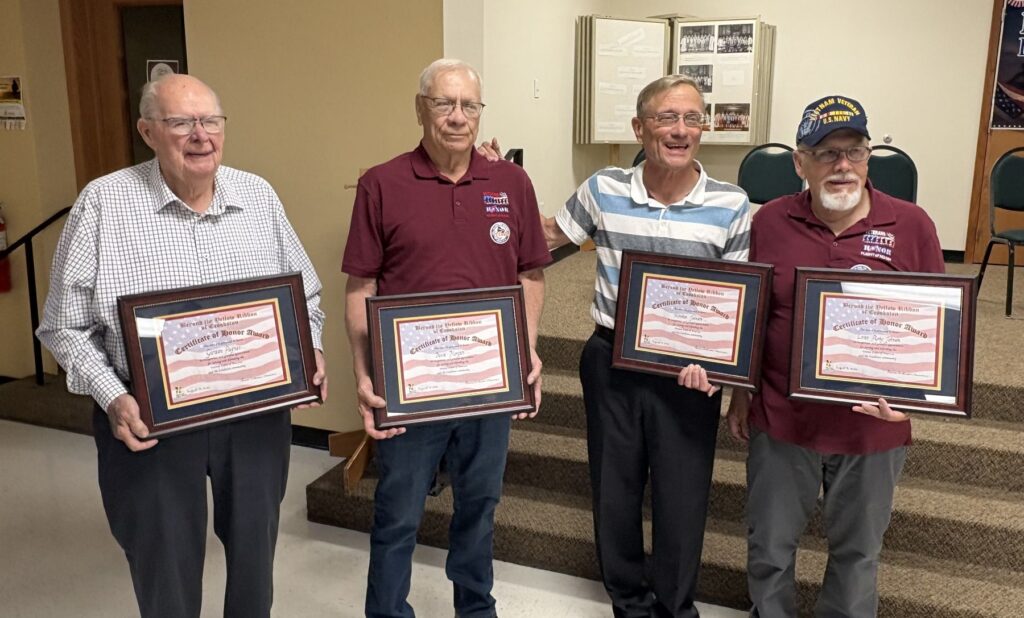
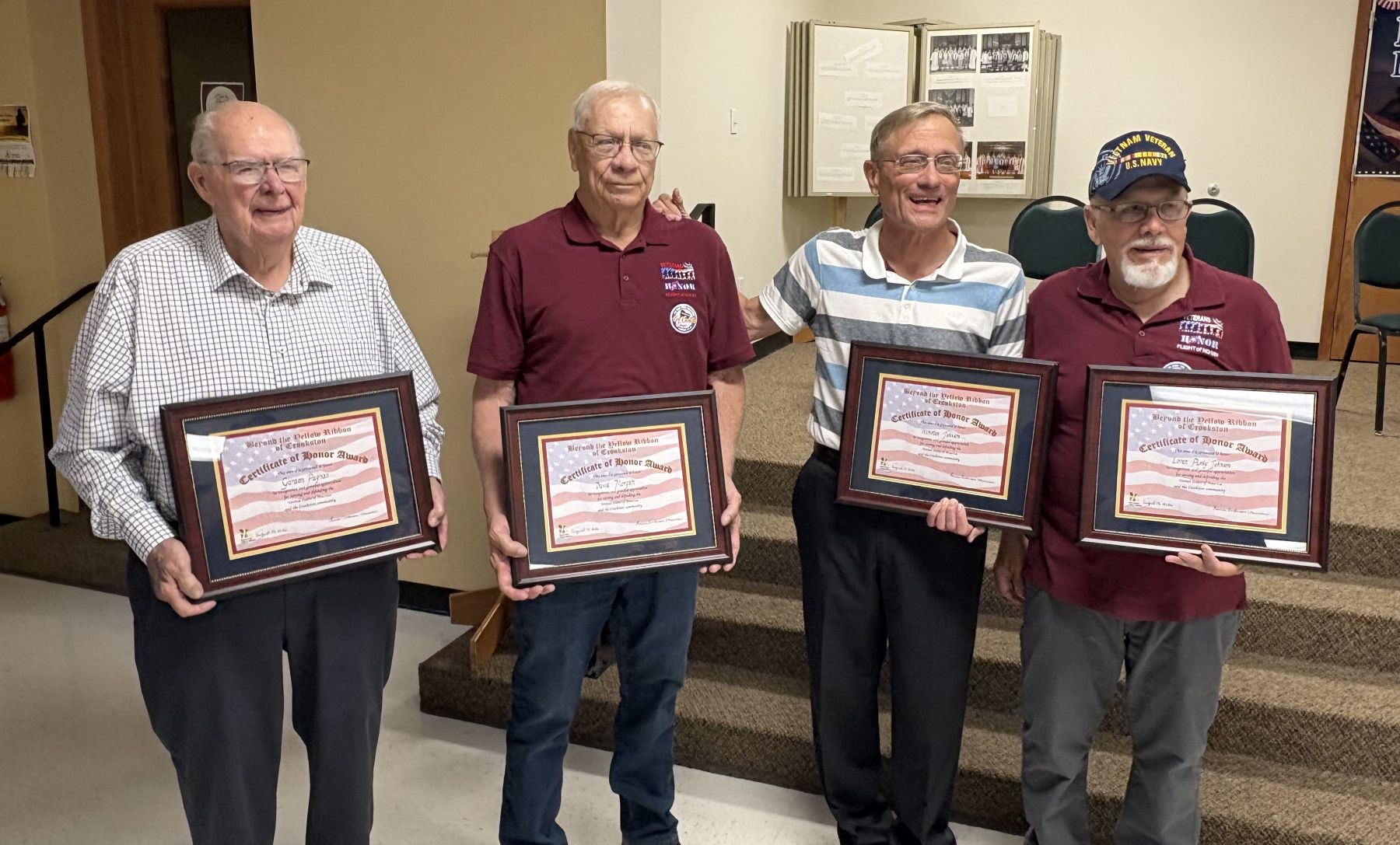
Loren “Punky” Johnson, David Morgan, Gordon Pagnac, and Winston Johnson were recognized for their military service during the 16th annual Veterans Ceremony at Trinity Lutheran Church on Saturday.
The ceremony is organized by Beyond the Yellow Ribbon, a community-led group that works with the DAV Auxiliary Unit #14, Crookston American Legion Auxiliary Unit #20, VFW Auxiliary #1902, and other groups to provide resources and support to active military members, veterans, and their families. Each veteran recognized received a certificate of appreciation and a Quilt of Valor.
Punky was grateful to everyone who attended the event and appreciates how the community comes together to honor its veterans. “It’s great. A lot of these veterans need this,” he said. “Nobody’s ever talked to them before, said thank you or stuff like that. But I want to thank the committee that’s in charge of this. They did a great job. They’ve honored a lot of vets, so it’s great to be one of them.”
Winston has always enjoyed the annual Veterans Ceremony as a spectator, but he appreciated being recognized as one of the honored veterans this year. “Well, I was truthfully rather be in the audience, but I’ll represent for the fellas, and you know it’s a very great honor to be asked to be honored among the four men this year,” said Johnson.
David was also thankful to receive this recognition from his community and shared a unique story from his time in the Philippines. “It’s just something we used to do in them days. Everybody went in and did their deal, and it shows you how small the world is,” said Morgan. “I was in the Philippine Islands, and I met a fellow Fisherite from halfway across the world. It’s unbelievable, but it’s a very nice honor today. I appreciate it, and thank you very much.”
Gordon was happy to see the many friends he’s made in Crookston over the years, talk about his service in Alaska, and be recognized for his service. “I enjoyed it. I was up in Alaska, and we did a lot of good things up here, and helped the civilians up here also,” said Pagnac. “So that’s what I enjoyed the most. It’s pretty special, real special.“
You can read the biographies of these four veterans below.
Loren “Punky” Johnson – Loren Irving Johnson is a distinguished veteran of the United States Navy. Many know him as “Punky”, and today, we are pleased to recognize him for his faithful and honorable service to our nation. Through Steadfast dedication, personal sacrifice, and unwavering commitment to duty, Punky upheld the proud traditions and core values of the United States Naval Service-honor, courage, and commitment. Punky served two years, 10 months, and 9 days in active service, enlisting in 1964 as a seaman recruit, concluding his tour in 1967 as a Petty Officer Third Class E4. When asked why the military, he replied, “I had just graduated, my friend was having girl and other problems and said ‘Let’s join the Navy!” He was not 18 yet, so when he and his friend signed up in Fargo, September 10, 1964, he had to bring paperwork home for his mom to sign, granting permission to go. Punky completed his basic training, boot camp, in San Diego, California. He spent 36 weeks in Treasure Island, San Francisco, for electronics school, earning electronics tech radar (ETR) status. From there, he was stationed on the USS Colonial LSD-18, a dock landing ship headed for West Pac based out of Subic Bay, Phillipines. Like many, he visited several ports: Japan, Okinawa, Hong Kong, and Guam. The USS Colonial carried many military items to ports up and down the coast of Vietnam. Barge to SaigonBrown Water Navy boats, also serving as a relief for troops, the USS Colonial would anchor offshore and go in and pick up troops and have them stay on the ship for relief and safety. As a dock landing ship, the Colonial’s primary mission was to transport and launch landing craft to support amphibious landings. This made her a key asset in amphibious deception operations where the movement of ships and landing craft could be used to mislead enemy forces about the location or timing of an actual assault. She participated in multiple advisory and combat operations, including Tet Counteroffensive support, where amphibious and landing craft movements could be used to mask troop deployments. Punky earned the Vietnam Service Medal, the Vietnam Campaign Medal, and the National Defense Service Medal (1-Star) with an honorable discharge July 18, 1967. In 1984, he re-enlisted in Fargo’s Naval Reserve, with San Diego as his mobilization site. His tour in the Navy Reserve earned him the Navy Achievement Medal (1st Star), a Good Conduct Medal, the Naval Reserve Meritorious Service Medal, the Armed Forces Reserve Medal, and Expert Rifleman Medal, retiring as a Reserve E6 in 2002. Punky’s wife of 58 years, Carol, shares his retirement. Their son, Chad, and daughter-in-law, Dana, have three sons., Brandon (and his wife Veronica), Ian, and Zach. He has two granddaughters, Nora and Naomi. Family has always been number one. When asked about a life lesson that stood out, he stated “joining the Navy was the smartest thing I ever did, next to marrying Carol.” The strength of our country is built upon the sacrifices and dedication of men and women like Punky whose service has left a lasting legacy of patriotism and excellence. On behalf of a grateful community, we extend our deepest respect, appreciation, and gratitude for your service to the United States of America. Thank you, Loren, fair winds, and following seas.
Winston Johnson – Winston Johnson joined the Navy in 1971. He chose military service because he was not interested in college and did not know what to do. His twin brother, Warren, entered the service a few months later and was asked if he had any relatives serving. They ended up on the same ship in the same department! Winston was inducted in San Diego, California on March 23, 1971. He completed his basic training there on June 23, 1971, and was assigned to the USS Ticonderoga in San Diego. The crew numbered 1500 when in port and 2500 when out to sea. Winston worked in the ship’s post office and helped with any other duties as assigned. After the Ticonderoga was decommissioned, Winston served on the USS George McKenzie, a destroyer. The mission of George McKenzie was to protect aircraft carriers. She held a compliment of 250. Winston reported to deck force, which meant manual labor when out to sea, and worked in the ship’s post office when in port. Winston served during th Vietnam War, but the closest he got to combat was when the Ticonderoga engaged in anti-submarine warfare in the Gulf of Tonkin off the coast of Vietnam. For 1-2 months, the ship sent helicopters up to drop deep sonar. They were looking for Russian submarines. They were not close enough to see the coast, and their only connection to the outside world was the Commander’s nightly reports. During his service, Winston earned the Vietnam Service Medal and National Defense Medal. He was discharged on March 23, 1975. His rank at the time was Postal Clerk 3rd Class (e-3). He had to be talked into taking the new rank. Among his favorite memories was Christmas of 1971. Winston was working when a shipmate came into the post office., looked at him funny, and said, “A guy that looks just like you came on board last night.” He took Winston below, and there was Warren, his twin brother. He had spent his first night on a berth by himself and did not know where anything was! Fortunately, Winston had an empty bunk in his berth, so they became roommates and were both assigned to the post office. One of his most exciting experiences was when Ticonderoga was assigned to pick up Apollo 16 on splashdown in April of 1972. It was a clear, balmy day, and uniforms were required to be on deck. He recalled a pop and then the white and colored shoots appeared. The astronauts went into quarantine, so the crew only met them briefly. Work experiences included whenever the ship docked at a foreign port, the ship’s compliment would “Man the Rail”. Dressed in uniform, they would line the rails and stand at attention. He remembered being in dry dock in the Philippines and being assigned to paint the ship, all that gray! The most exhilarating thing was when he was taken by prop plane into the nearest port to pick up mail. Taking off the aircraft carrier and then “catching the wire” to land back on board was an experience not to be forgotten. The carrier had two chaplains, so he took advantage of church services, bible studies, and met some older sailors who took he and his brother under their wing. They showed them the ropes on board and around San Diego when they were in port. He felt his adult faith developed during that time, as well as some lifelong friendships. He learned to work with the rest of the crew to accomplish the goals assigned and found it rewarding to touch the lives of everyone aboard in the mail room. Both ships that he served were docked in San Diego, so he got to know the city well. He was always the first one off when they arrived to port so he could pick up the mail. Winston’s twin brother was transferred to Australia when the Ticonderoga was decommissioned. There, Warren met his wife, Sandra. They have three children: Rowon, Bonnie, and Laurie. When Winston’s parents, Richard and Inga, were living, Warren and his family would come for Christmas every couple of years. After his parents passed, Winston began visiting his brother and family in Australia, staying for about six weeks at a time. Winston is now basically retired. He worked at Riverview for 32 years, then for Jodi Jorgenson for 10 years and now does personal care on a one-to-one basis when he is needed. Winston feels that he played a small part in the military, but it was rewarding and the comradeship is something that can’t be replaced. He is honored to have served his country. Being able to go on an Honor Flight brought back all those feelings. The Memorial Day services, particularly when the veterans present are asked to come forward, are special to him. To be honored alongside World War II veterans and older veterans is humbling.
David Morgan – Many people join the military out of patriotism and a desire to serve their country. David Morgan joined the Air Force partly because he disliked his job and saw military service as a better option than staying at a workplace that predated OSHA regulations. More importantly, his older brother, Bob, was already serving in the Air Force, so Dave followed his example. On January 6, 1965, he traveled by train from Grand Forks, North Dakota to Fargo, North Dakota to enlist. Basic training was at Lackland Air Force Base in Texas. After six weeks there, Dave went to Amarillo AFB for about four months. His next location was Clark AFB in the Philippines. This was his home for about a year and a half before coming back stateside to the Grand Forks AFB. He stayed here until he was honorably discharged as a Sergeant (E4) on October 4, 1968. Dave received a National Defense Service Medal, Small Arms Expert Ribbon, Air Force Outstanding Unit Award, and Air Force Good Conduct Medal. His role while at Clark AFB was to be in direct support for those in Vietnam by supplying ordered materials – specifically punch cards for IBM. He said he worked eight hour days, seven days a week when he first arrived, earning approximately $78/month. When he was at Grand Forks AFB, he put his IBM punch card experience to work and taught expertly about the cards he once supplied. With back-to-back workdays upon his arrival at Clark AFB, he would donate blood if he wanted a day off. He took advantage of this a few times. The Everly Brothers (“All I Have to Do Is Dream”, “Bye, Bye, Love”, and “Wake Up, Little Susie”) had an Asian tour Dave thought he would partake in. He got more than a concert when they joined his table during an intermission. Speaking of celebrities, Dave was able to spend a little downtime with a Philippine civilian who did training as new troops came in. He (and a friend) spent a long weekend away from base with him, and kids treated them like A-list movie stars – not because of their rugged good looks but because they had American money. Since he was not raking in a big salary, he had to learn how to stretch a dollar. At the time, $1 was worth 4 Philippine pesos and 86 centavos. The beer cost 25 centavos then. That equals 19 beers with a little change to spare. What affected him most during his service were hangars that stored pallets of things he would count during inventory. He found out that they were body bags and embalming fluid that would be shipped out by the hundreds during inventory counts. Ever the socializer, Dave saw someone he grew up with (in Fisher) while in the Philippines, thus proving that it is a small world after all. Both ended up working at the post office once their service was done. Socializing stateside brought him to the Armory in Crookston, where he met his future bride, Sandy, at a dance. He put a few miles on whilst wooing her since he lived on base. Once they married, he had to drive back and forth from Crookston. Dave admitted that he was “ornery” and “wild” when he was a teenager. The military made him grow up quickly and shaped him into who he is now. He learned order and respect. He learned to obey without questioning. He learned how to quickly convert American money into Philippine pesos. He believes that everyone should serve their country (if only for a while) for the possibility to better not just themselves, but also our country, and learn the same life essentials that he did. If one is given the chance to go on the Veteran’s Honor Flight, he says to GO! He had a wonderful time when he went. It was an experience he will always remember. Once his service was done, he dove headfirst into a variety of things. He hauled sugar beets, he was the first bartender at the Irishman’s Shanty as he went to UMC, he was an assistant manager at SuperAmerica until he worked at the United States Post Office for just over 32 years. He later worked at the courthouse for over 11 years. His hobbies these days consist of a variety of things – like playing cards, enjoying a good book, and being a human calendar, down to the minute, sharing life events with everyone he has a phone number for. He has been married to Sandy for almost 59 years. They have two children, Lonnie Morgan and Melissa & mtt Hesby, four grandsons, Devin Morgan and Nathan, Jacob, & Joshua Hesby. Joining the military might not have started as a calling for him, but it turned into something he enjoyed. He is proud of his time in the Air Force and values what he took with him during that time.
Gordon Pagnac – Gordon (Gordy) had a tough time at school. I just did not like school and joined the Army to get on with life. So, on March 18, 1958, I went to Fargo and entered the Army. I completed my basic training at Fort Carson, Colorado on May 1, 1958. I then went to Fort Sam Houston in San Antonio, Texas for three months, and on August 1, 1958, I was trained as a medic. I did not realize that I would have to study, as I did not like school all that much. My next destination was at Eielson Airfield in Alaska. The Air Force collaborated with the Army near Fairbanks, Alaska. I started off in the motor pool for six months and then transferred to a radar missile site for security. We were watching Russia, and Russia was watching us. We were always told there could be athreat from Russia, as they were not that far away even though it was peacetime. There were 19 of us at this site. Most were from Iowa, and there were two foreigners in the mix. I had to maintain the generators to keep them level, as there were many tremors due to earthquakes. I had KP once a month to help the chef, as we were on a rotation schedule. The USO would take us on outings, and I remember when we would fish for graylings, they were beautiful indescent fish. Other outings were downhill and cross-country skiing and camping within 30 to 40 miles of our base. I never saw a grizzly bear, however, we knew they were there. I was discharged on February 25, 1960, and on October 13, 1961, I was called back during the Berlin Crisis. I was stationed at Fort Lee, Virginia. We were building a 12-foot sidewalk per day, and we did this until we finished the job. I was then released on August 8, 1962. Gordon received a Good Conduct Medal, Sharpshooter Badge (Carbine), and an Expert Sharpshooter (Carbine). His rank was Private First Class (T) (E-3). After my discharge, I worked in construction for four years. I then worked at the fertilizer plant in Stephen for two years. A position came open for a manager at Cargill Fertilizer Plant, and I held that job for nine years until the plant left Crookston. I was also at the Crookston Fire Department for 30 years until my retirement. My wife, Maxine, and I have been married for 63 years and have four children: Lynell and Jacob Poulson in Denmark, Carlene and Tommy Kearns in New York, Darren and Angie in Bemidji, and Jami and Matt Schumacher in Grand Forks. Grand children Molly, Mia, Lander, Bennet, Max, Sam, and Eliot. Great-grandchildren Ryker, Beesley, and RJ. Granddaughter Mia and Reese Stelow in Wisconsin. I went into the service at 17. I was just a kid, and it made me grow up. I learned to take care of myself and that life is not always easy. I learned about all diverse cultures and having good relationships with others. I had a good life and am proud of all my children.