National Rural Health Day is observed on the third Thursday of November, which falls on November 19 this year. The day celebrates the “Power of Rural” and honors the doctors, nurses, clinic staff, and community health workers who provide care with limited resources. It also highlights challenges rural communities face, including provider shortages, long drives to care, and an aging population.
Research on Long-Term Care
Assistant Professor Annette Roter and Associate Professor Julie Hinders, director of the health management program at the University of Minnesota Crookston, are leading two research studies examining how workplace conditions affect the care older adults receive in nursing homes. Roter has spent years studying dysfunctional leadership in health care and has authored a textbook on the subject. Hinders is a former licensed nursing home administrator who has worked in both urban and rural settings.
The first study examines upward bullying, which occurs when employees repeatedly target their own supervisors or managers, often to push them out. Little is known about this kind of bullying in health care. Roter and Hinders are surveying long-term care leaders about what drives it and how it affects them, their employers, and their residents. Rural facilities may feel the effects most. They draw from a smaller pool of workers, so staff is hard to replace.
“In rural healthcare, challenges like geographic isolation, high leadership turnover, and severe workforce shortages don’t just create longer wait times,” Hinders said. “They can lead directly to nursing home closures, service reductions, and families having to travel long distances for care.”
The second study looks at elder abuse in nursing homes across the country. Using inspection data from the Centers for Medicare & Medicaid Services, the team will compare abuse rates across rural and urban facilities, for-profit and nonprofit facilities, and regions. The goal is to find patterns that could lead to better oversight, policy, and management.
“This work speaks directly to UMN Crookston’s mission of serving rural communities,” Hinders said, “by addressing the real, day-to-day challenges that long-term care facilities face.”
Five UMN Crookston students are helping with both studies: Roland Bartels, Nghi Luu, Diane Cilengi, Najeem Sekoni, and recent graduate Kavya Singh, who has stayed on as an alumni contributor.
The students have helped with literature reviews, consent forms, survey design, the Institutional Review Board approval process, and survey reports. Two of them recently received funding through the University’s Undergraduate Research Opportunities Program, which gives stipends to students who do research with a faculty mentor.
“This has been a learning process for all of us,” Roter said. “We are teaching the students, but they are also teaching us.”
Programs for Future Health Professionals
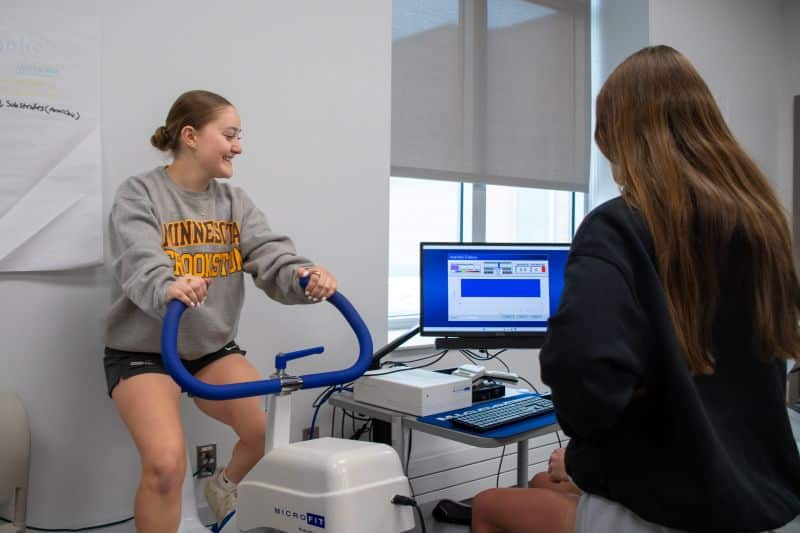
UMN Crookston also offers several majors for students who want to work in health care such as biology, exercise science and wellness, health sciences, health management, applied health, and medical laboratory science.
Health sciences is an on-campus program that prepares students for careers in health care or for professional programs in medicine, dentistry, pharmacy, physical therapy, occupational therapy, chiropractic care, optometry, and veterinary science.
Applied health is an online program for students who hold an associate degree in an allied health field and want to build supervisory and management skills. Health management, offered online, focuses on leadership, policy, and administration, and it is approved for nursing home administrator licensure in Minnesota.
Health and Wellness Resources on Campus
UMN Crookston looks after the health of its own students. University Health Services provides medical care, treatment, and referrals, and Counseling Services offers confidential counseling, psychiatric care, and referrals to other mental health resources.
Students can also use TimelyCare, a free virtual health platform open twenty-four hours a day, seven days a week, with no insurance required. It offers on-demand and scheduled medical appointments, mental health counseling, emotional support, and health coaching.
For physical health, the Nielsen Family Wellness Center has fitness and cardio equipment, a two-court gymnasium, an indoor walking and running track, and space for group exercise.
Together, these programs and services help students prepare for careers in health care while supporting their well-being along the way. Rural health care depends on the people who give care, the communities around them, and the education of those who will come next.