Minnesota’s summer heat and unpredictable rainfall are creating drought conditions across much of the state, which can stress neighborhood trees. The Minnesota Department of Natural Resources encourages homeowners, residents, and community tree caretakers to help newly planted and established residential trees stay healthy during dry conditions.
Unlike trees growing in forests, residential trees – such as those in yards – often face additional stress from compacted soils, limited rooting space, reflected heat from pavement, and competition from other vegetation. Drought stress can make trees more susceptible to insects, diseases, and other environmental challenges. During extended dry periods, supplemental watering can help reduce stress and improve tree health.
“Watering trees during extended dry periods is one of the simplest and most effective ways people can support the health of their landscapes and communities,” said Rachael Dvoracek, DNR community forestry project specialist. “A little attention now can help trees thrive for years to come.”
Newly planted residential trees need extra care
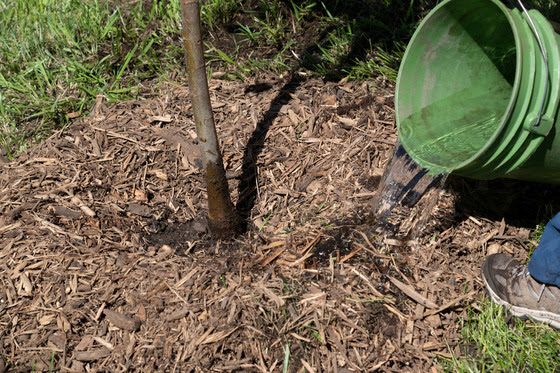
Newly planted residential trees need 15-25 gallons of water once a week for the first three to five years after the ground thaws in the spring and until the ground freezes again in the fall. People can skip watering if more than one inch of rain has fallen in the previous week.
Effective watering methods include:
- Setting a garden hose on a slow trickle for one to two hours and moving it around the tree periodically.
- Slowly pouring water around the base of the tree using a large bucket.
- Using a tree watering bag and refilling it as needed.
Watering during the early morning or late evening helps reduce evaporation and conserve water. Also be mindful of any watering restrictions in place.
These guidelines may vary depending on tree size, species, planting site, or environmental conditions. If trees are showing signs of stress, people can contact a local arborist certified by the International Society of Arboriculture, or a Tree Care Advisor (mntca.umn.edu/find-tca).
Don’t forget mature trees
Established trees also benefit from supplemental watering during prolonged dry spells.
Water the soil beneath the entire canopy, a few inches away from the trunk to the outer edge of the branches. A soaker hose works well for this purpose, or homeowners can use a garden hose set to a slow trickle and move it around the tree periodically. Water long enough to moisten the top 6 inches of soil.
Mulch matters
Proper mulching helps trees retain moisture and moderate soil temperatures.
Apply mulch to a depth of about 3 inches in a donut-shaped ring around the tree, keeping it several inches away from the trunk. Avoid piling mulch against the bark, which can contribute to decay and pest problems.
Healthy trees benefit everyone
Healthy community trees provide shade, reduce energy costs, improve air quality, intercept stormwater and make neighborhoods more comfortable during hot summer weather. Protecting trees during dry periods helps communities continue to receive these benefits for years to come.
More information about tree care, watering and pruning is available at the DNR’s Residential tree planting and care webpage (mndnr.gov/treecare).