
The University of Minnesota Crookston is proud to announce Associate Professor Brian Dingmann, Ph.D. as a recipient of the 2025-2026 Fulbright U.S. Scholar Award. He is the first faculty member to receive this honor since retired associate professor Richard Christenson, Ed.D., was named a Fulbright U.S. grantee during the 1974-75 school year when the campus was the University of Minnesota Technical Institute.
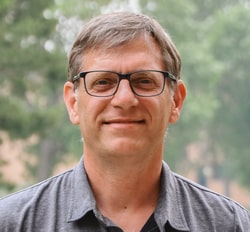
The Fulbright award supports a semester of teaching, research, and international collaboration. Dingmann will be hosted by the University of Szeged in Hungary during Fall 2025 as part of the Fulbright-University of Szeged Scholar Award. “This award is a tremendous honor, both personally and professionally,” shared Dingmann. “It reflects not only the work I’ve done, but the values of UMN Crookston in promoting global citizenship and innovation in teaching and research.”
During the semester in Hungary, Dingmann will be teaching a master’s-level Ecotoxicology course, co-taught with UMC Associate Professor Katy Chapman, Ph.D. The course, which focuses on the effects of toxic substances on ecosystems, including how pollutants move through the environment and impact living organisms, will utilize the Collaborative Online International Learning (COIL) framework connecting students in Crookston and Szeged in a joint educational experience. Through COIL, students from both institutions will engage in shared learning projects, gain cross-cultural competencies, and explore environmental issues from a global perspective.
“I’m excited to connect students from both universities through a shared learning experience,” added Dingmann. “The COIL model will allow our students to explore global perspectives on ecotoxicology and learn from one another.”
Dingmann’s research will investigate a biopolymer produced by rotifers or microscopic aquatic animals. Dingmann says the microscopic creatures help maintain a healthy balance in the food chain and serve as sensitive indicators of pollution, making them valuable in environmental studies.
“My research focuses on a natural substance (a biopolymer) produced by male rotifers during mating,” he explained. “Early findings suggest that this sticky substance, called Rotimer, helps males connect with females. However, scientists still don’t fully understand why or how it’s made, or what exactly triggers its release.”
During his project, Dingmann will be studying how this biopolymer influences mating and communication, investigating the role of calcium in the process, examining how the surface of female rotifers might help guide mating behavior, and exploring whether a special organ in male rotifers is responsible for producing the biopolymer.
“This research is vital because understanding rotifer reproduction helps scientists better assess water quality, biodiversity, and the resilience of aquatic ecosystems, both locally and globally,” Dingmann continued. “The study also supports international collaboration and scientific exchange, providing students at both the University of Szeged and my home campus in Minnesota with an opportunity to work together on shared environmental challenges.”
Potential impact from this research locally and region-wide, said Dingmann, could help improve water monitoring in European freshwater systems, such as the Tisza River near Szeged. Globally, the findings could lead to improved methods for utilizing rotifers in ecological testing, conservation, and biotechnology applications.
Dingmann will work with Dr. Zsolt Datki and mentor a Hungarian master’s student during his research at the University of Szeged.
“This Fulbright gives me a chance to explore their potential in a world-class research setting,” Dingmann expressed.
For public engagement, Dingmann will give community-facing lectures at the University of Szeged Botanical Gardens. He will also participate in the American Corner Szeged’s Conversation Club, engaging local audiences in discussions on environmental science, international education, and U.S. academic opportunities.
About the Fulbright program
The Fulbright program, established in 1946 by Senator J. William Fulbright, is the U.S. government’s flagship international educational exchange program. Sponsored by the U.S. Department of State, it promotes mutual understanding and collaboration between people of the United States and those of other countries. The Fulbright U.S. Scholar Award is one of the most competitive and prestigious academic honors, with only a small percentage of applicants selected each year. Recipients are chosen for academic excellence, leadership, and potential for international impact. Fulbright alumni include Nobel Laureates, Pulitzer Prize winners, and heads of state or government.