The Crookston City Council met on Monday at the Crookston City Hall council chambers.
The council unanimously approved the consent agenda, which included cement mason licenses for 2026 to Palmer Masonry & Concrete and A & S Concrete, LLC., and the appointment of June Donarski to the Crookston Development and Policy Review committee.
The council approved the satisfaction of a deferred loan repayment agreement with Michael Q. Schultz, approved a $100 donation to the Crookston Park and Rec from Chuck Leonard and Lynn Tiedeman in memory of Jackie Frants.
The last item to be approved was a resolution authorizing the Crookston Fire Department to enter into a fire service agreement with the Regents of the University of Minnesota Crookston for services outside of the city limits. The agreement provides a lump-sum annual payment of $1,500 in advance and further addresses hazardous materials response costs and extended-duration emergency response costs. The agreement is from January 1, 2026 through December 31, 2026.
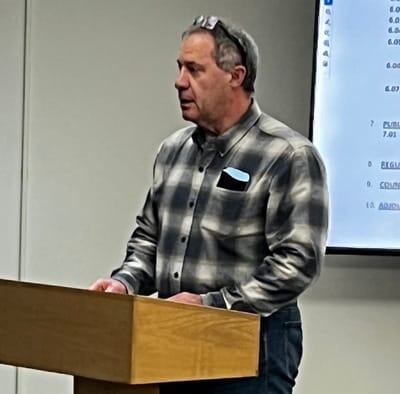
There was a public hearing for an extension of the Minnesota Investment Fund (MIF) for Northstar Lime LLC. The only person to speak was Phil Schramm (pictured right), COO of Northstar Lime LLC, to give a reason for the extension and to answer questions from the council.
The Minnesota Investment Fund is a Minnesota Department of Employment and Economic Development (DEED) program that provides financing to attract new workers and retail high-quality jobs statewide. The focus is on industrial, manufacturing, and technology-related industries to increase the local and state tax base and improve economic vitality statewide.
In December 2023, the City of Crookston entered a MIF agreement with Northstar Lime, LLC to support capital investment and job creation in Crookston.
As part of the MIF funding, Northstar Lime needed to employ 21 people, but they currently employ 17 due to significant operational challenges with its pyrolyzer equipment for biochar production, which has limited its expansion and delayed additional hiring. “We got approved approximately two years ago for a loan/grant arrangement, which basically amounted to a loan with a portion of it forgivable if we employed a certain number of people that we had in our projection,” said Schramm. “And that we are currently just slightly short of that number. And the rules allowed us to get a one-year extension to meet that employment level.”
Schramm said they ran into equipment issues, which prevented them from hiring as many people as they had hoped in the first two years. “One of the things that you just chalk it up to, you know, learning school hard knocks is the product that we purchased, we learned that was kind of a first series item in the manufacturing. And… We just learned that it wouldn’t be able to withstand the rigors required to maintain. And so with that, we’ve had a lot of downtime with it,” said Schramm. “We tried to work with the manufacturer, and the manufacturer went out of business. So all those things were complicated and delayed. So originally running this machine would require, you know, up to two people per shift. So, you know, you factor that in, and we would hit our goals. So it’s just things like that, you know, currently that you just don’t foresee, but they happen.”
WHAT DOES NORTHSTAR LIME DO?
KROX asked Schramm what Northstar Lime makes at its plant in the Industrial Park. “Right now we’re making lime pellets. If you’ve ever gone by American Crystal and you see those big hills, one of them looks white, that’s all waste lime or what they call spent lime that American Crystal has used in their sugar-making process. And when they’re done with it, they put it in a landfill, and all their landfills are filling up,” said Schramm. “What we’re trying to do is take a waste product because it has a very valuable use as a soil amendment to soils that have low pH, plus it has nutrients in it, particularly calcium, that are in demand for farmers in the upper Midwest. So we’re trying to figure out ways to convert this product, which is a powder and hard to handle, into a form that’s easier to handle and compatible with the farmer’s existing equipment.”
Northstar Lime is also working with Biochar, which is taking another waste product and trying to develop it into something useful. “Currently, we are working with several different outfits. There are kind of two aspects to it. One is taking what they call biomass, which is basically feed stocks. They can be wood. They can be different like crop residues, like oat hulls, sunflower hulls, even things like beet pulp are capable of being able to be utilized,” said Schramm. “How that works is by burning it, you create ash. These furnaces are unique in that they burn without oxygen, essentially, and, in that chemical process, they either produce or sequester carbon. And a lot of the climate sector, in addressing that, wants to reduce the carbon that goes into the atmosphere. So this is a way to sequester it and put it back into the soil, even in concrete or whatever, so that rather than it fixing into the air right away, it’s sequestered for tens and hundreds of years.”
Northstar Lime continues to look at new products it can make. “We’ve got a lot of exciting things going on that are currently in research stages. But I think, as a company, we have a lot of exciting things ahead of us. The technologies and the needs that are out there,” said Schramm. “Anytime you can take something that’s a waste and turn it into something that’s productive, you know, there’s a feel-good about it, but it’s also providing sustainability, which is getting to be more and more important.”
The Council approved the one-year extension unanimously.