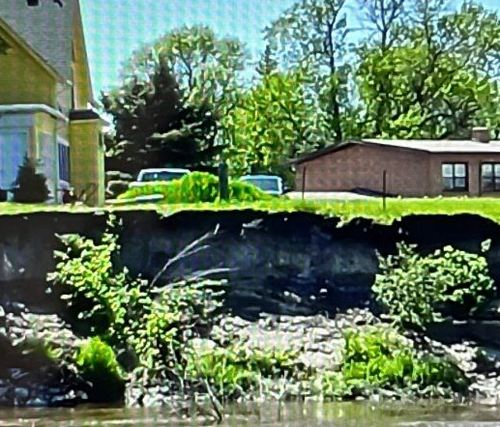
The Crookston Ways and Means Committee met on Monday night after the City Council meeting and discussed a TIF District for the old Diocese property and the Houston Avenue erosion issue.
TIF DISTRICT AT THE OLD DIOCESE PROPERTY
The City of Crookston has an option on the old Diocese property and plans to issue a Request for Proposals (RFP) to determine whether any developers are interested in developing the site for residential homes.
Prior to issuing the RFP, Crookston Housing and Economic Development Executive Director Taylor Wyum asked the committee if the City would support the establishment of a Tax Increment Financing (TIF) district for this property to try to attract a developer. “A TIF district is a tax increment financing district, and it’s a financing tool or an incentive tool that cities can use in a variety of different settings,” said Wyum. “In this particular case, it would mean that any new development on the property that would generate property taxes, anything additional to the current property tax amount is considered that tax increment, and those monies are used by cities or developers to further finance projects. And with that, the idea of it is to entice a developer, which would be obviously great for the city to have a bunch of housing, but also to bring a developer in that could get the project done.”
The land value now is $892,000, but the City isn’t collecting any tax revenue because it is owned by the Catholic Diocese and church entities don’t have to pay property taxes.
The Development would consist of market-rate housing with the property currently zoned single-family residential. Depending on developer proposals, a zoning change may be requested to allow for additional housing types, such as twin homes. The property is a 20-acre parcel with mature trees, located south of Minakwa Golf Course and north of Memorial Drive. “It’s a beautiful 20-acre property with mature trees. It’s in a well-established neighborhood, beautiful to walk around in that neighborhood,” said Wyum. “We’d really like to see some single-family homes, some market-rate homes come up along the golf course there, all over the 20-acre property. Ideally, keep some of those mature trees, keep that beautiful scenery, and it’ll really feel like an established neighborhood, even though it’s new.”
HOUSTON AVENUE EROSION ISSUE
Several residents from Houston Avenue attended the meeting for the Houston Avenue erosion issue. The Red Lake River has slowly eaten away at the backyards of eight homes on Houston Avenue, at the entrance of the Woods Addition. There are eight homes that have seen anywhere from a few feet to 40 feet of their backyard disappear over the years. To buy out the eight homes, Interim City Administrator Daren Selzler said Polk County has the property tax valuation of the eight homes at $1.2 million. Demolition of the homes would cost between $450,000 and $850,000. Riverbank stabilization would cost between $1.7 million and $2.2 million.
The residents wanted the City to make a decision by the end of March, and Selzler said they cannot move quickly because they don’t have the money to cover the cost of the project, and have to get all the numbers figured out and determine where they would get money to pay for the project. Houston Avenue resident Gail Meyers has put a lot of work in and was hoping the City would be ready to move forward now. “I’m one of the homeowners on the Houston cliff, which is really representative of what’s happening because we’ve got severe bank erosion, bank erosion that threatens lives, property, water quality, habitat. There’s a whole list of issues threatened by the severe bank erosion we have. And so when the city announced that this was the home removal looking like a possibility back in 2023,” said Meyers. “We have to work as a group, and I’ve been calling and speaking to a lot of people since then to try to find grants or to try to get help for what we need. We want to get a bill written, so I came to the city council to get some assurances that they could sponsor this bill without any financial obligation, but to approve the concept of what we needed to do, and then let the work of the finances come as this moved forward.”
Selzler said the City will be working with the residents, but they can’t get it done in a couple of months. “It was a good conversation. I absolutely feel for the residents. I know we’re on a very tight timeline. As I expressed in the meeting, it might be difficult to meet that short-term timeline,” said Selzler. “I’m confident in our plan moving forward, forming a board, having members of Houston Avenue, some of the homeowners and others on that board, that we can keep on timelines, create timelines, and try to put these numbers together and meet the requirements set out by the state of Minnesota.”
Meyers understands the concern of not having enough time, but the homeowners are worried about their safety. “Tonight, I think what we came to was the council feels stressed to do this quickly, and I understand that. But I also understand our perspective that we are scared and threatened by what’s happening to our homes and our livelihoods. And even our safety. To have grandchildren, you can’t have people play in your, I mean, nobody can go near this. So what we wanted was some cooperation, and we did get that,” said Meyers. “What we want, though, is more urgency and more immediacy, and that’s what we’re struggling with right now, and I’m going to continue as quickly as I can to move this forward. I know the council said they were going to form a board or a committee. We welcome that. Government sometimes moves slowly, but we’re going to try to keep the urgency there in front so that this gets done and the buyout portion, the demolition portion, and the bank stabilization portion gets done.”
Selzler reiterated that the City is committed to working with the Houston Avenue residents. “We’re absolutely committed to working with those residents. We understand the safety concerns. This is a large-scale project. Like I said, it could, it could exceed $5 million. And part of that would require a 50 percent match on the city of Crookston or somewhere else and grants or other funding,” said Selzler. So again, we completely understand the safety piece of that, but there are so many moving parts, and it is a large-scale, very expensive project. So we want to make sure we do it right, that we get the funding in place and that, you know, one, we can do it to, you know, mitigate that safety risk and hopefully stabilize that riverbank for the future where it’s not a concern anymore.”
Meyers said the loss of the backyards over the past two or three years has been drastic. “There has been an escalation in the last several years. Yes, I’m reporting six to eight feet that’s been dropping in. We know that some of the ice has just been headed for us more fiercely on years of higher water,” said Meyers. “But we also know that the flow of the river sometimes is changed by what’s happened upstream. There have been changes. And so that affects us. I think the more that it erodes, the quicker it seems to happen. I don’t know all the reasons, and I’m not the engineer, but we’ve been asking for explanations on this so that we can get the urgency that we need to get solutions that will come forward.”