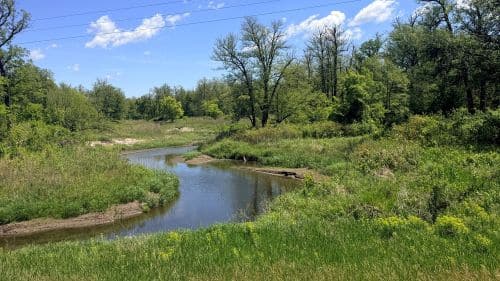
Clean Water Funds from the Minnesota Board of Water and Soil Resources (BWSR) supported conservation work that significantly contributed to the proposed removal of a section of the Sand Hill River in Polk County from the state’s impaired waters list. U.S. Environmental Protection Agency (EPA) approval finalizes the status.
Redhorse species and other migratory fish returned to the river after rock riffles and rock arch rapids replaced four dams on the river west of Fertile.
The $1.6 million project — backed by a $475,000 Clean Water Fund grant from the BWSR awarded to the West Polk Soil and Water Conservation District (SWCD), a $118,750 match from the Sand Hill River Watershed District (SHRWD), a $933,000 DNR Outdoor Heritage Fund grant, and a $100,000 Enbridge Ecofootprint grant — restored fish passage and improved habitat while maintaining streambank stability. It followed 20 years of watershed-wide work by local, state and federal partners.
“Without the Clean Water Funds, this wouldn’t be possible. There isn’t enough local tax base to be able to institute the type of projects that we’ve been able to put out there on the landscape. Those (funds) also support monitoring, planning, and restoration efforts. They support implementation of conservation practices that would reduce sediment or runoff,” said April Swenby, SHRWD administrator. “This delisting would highlight the value of the public investment in clean water, and it demonstrates that these investments can lead to measurable improvements on Minnesota’s rivers and streams.”
A 62-mile-long stretch was listed as impaired for fish habitat in 2014. Now, a 15-mile-long segment of that stretch — from Kittleson Creek to just east of Fertile — is poised to shed that impairment.
“The proposed delisting of the Sand Hill River validates over a decade of collaborative conservation work aimed at reversing ecological damage, signifying the success of targeted watershed strategies,” said Nicole Bernd, West Polk SWCD manager. She applied for the Clean Water Fund grant, facilitated the riffles project, and facilitated One Watershed, One Plan planning for the Sand Hill River watershed.
Now, Bernd said that Sand Hill River-related work focuses on comprehensive ecosystem restoration, flood mitigation, and water-quality improvements. The Sand Hill River Ecosystem Restoration Project Team is designing a habitat and channel stabilization project centered on a 3-mile priority stretch of river east of Beltrami. WBIF-supported work aims to reduce turbidity and E. coli via targeted agricultural and structural best management practices.
“(The delisting) validates our public funding, drives community engagement and (sends) the message that keeping healthy waters clean is far more cost-effective than attempting to restore them,” Bernd said.